More Efficient AI Does Not Guarantee Lower Total Use
AI can use less energy, money, or labour for each task while total use still rises. The missing piece is what happens to demand.
The short answer
More efficient AI does not automatically mean less total use.
If an AI task becomes cheaper or easier, people may do more of it. If demand grows faster than the savings from each task, total use can rise. If demand stays about the same, the savings can be real.
So the useful question is not only:
Did AI become more efficient?
It is also:
Efficient per what, and what happened to the total?
A simple example
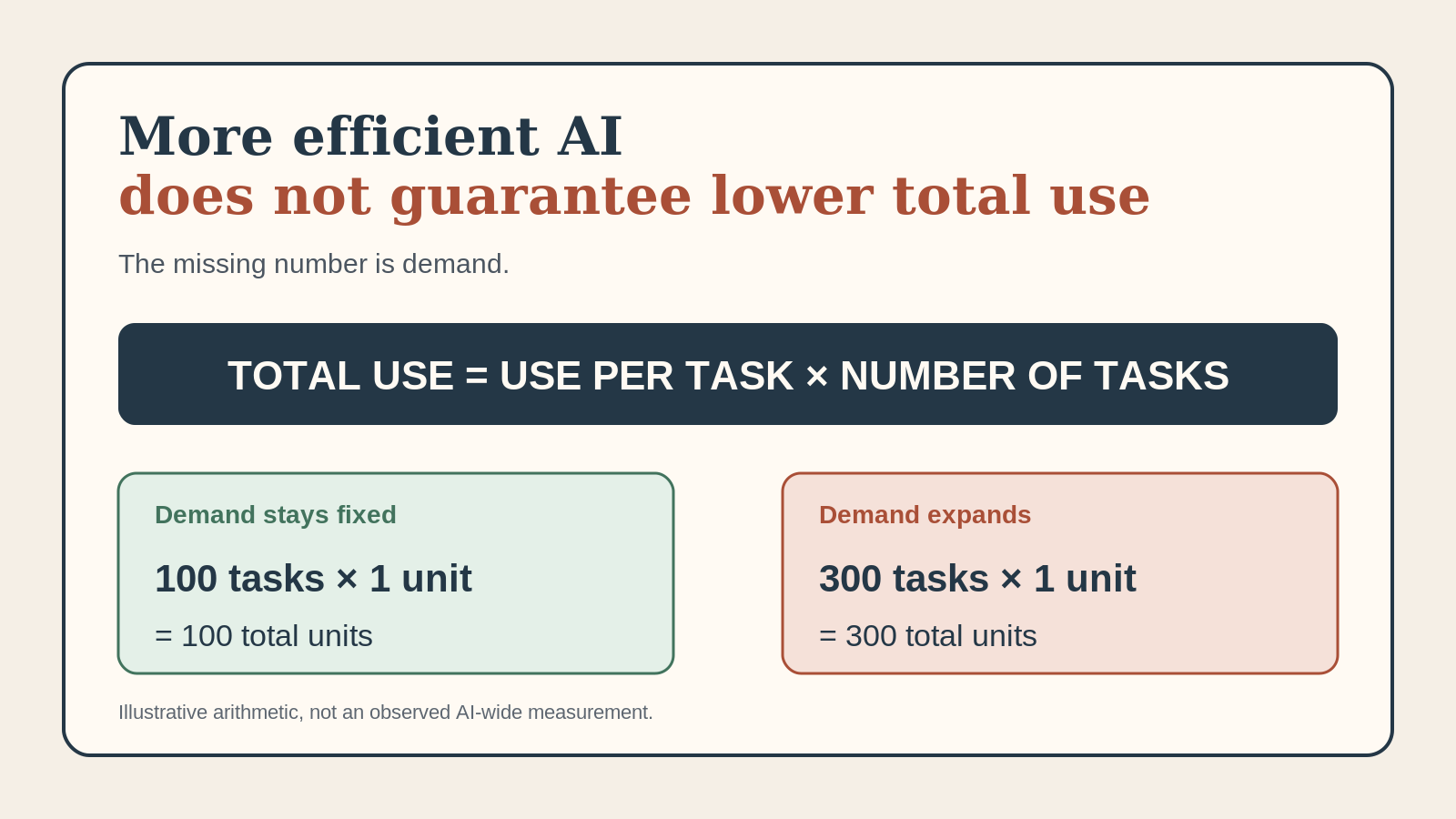
Suppose 100 AI tasks use two units of energy each. That is 200 units in total.
An improvement cuts the energy used per task from two units to one.
- If people still do 100 tasks, total use falls to 100 units.
- If the lower cost leads people to do 300 tasks, total use rises to 300 units.
Each task is more efficient. The total is still 50 percent higher than it was at the start.
This is the basic idea behind Jevons paradox. In plain English: making something cheaper to use can encourage people to use more of it. That does not happen every time. It is a possibility that must be measured.
What the evidence shows
One study looked at Chinese companies listed on stock exchanges from 2010 through 2022. The researchers reported that companies using AI had lower carbon emissions relative to their economic output, but higher total carbon emissions.
That distinction matters.
A company can become cleaner for each dollar of output while growing enough that its total emissions still increase. The study found an association, not a universal rule. It does not show what happens in every country, industry, company, or AI system.
The study also found that stricter environmental rules weakened the increase in total emissions. That is a useful reminder that demand, energy sources, prices, and policy all matter.
Other researchers have made a related argument: measuring the energy or emissions of one AI output is not enough if lower costs lead to many more outputs. Their work supports the warning, but it does not provide a reliable number for the size of an AI rebound across the entire economy.
That number is still unknown.
What this does—and does not—say about jobs
The same reasoning is sometimes used to argue that AI productivity will protect or increase employment. That conclusion is not established.
AI might reduce the labour needed for one task while creating enough new demand for some related work. It might also allow a company to produce more with a smaller team, remove entry-level tasks, reduce rates, or send most of the gains to owners and platforms.
Several things can change at once:
- output;
- headcount;
- wages;
- hours;
- job quality;
- entry-level opportunities;
- review, security, and integration work.
More output does not prove that there are more jobs. An efficiency chart cannot tell a worker whether a career is safe or in danger. That requires evidence about the specific occupation, including tasks, hiring, wages, and demand.
Efficiency can still reduce total impact
The warning is not that efficiency is pointless or that total use must rise.
If demand stays fixed, efficiency can reduce total consumption. Cleaner energy can reduce carbon impact even when computing activity increases. Capacity limits, prices, environmental rules, and other policies can also prevent extra demand from wiping out the savings.
The narrower conclusion is this:
Technical efficiency by itself does not guarantee a reduction in total impact.
It also does not prove that total impact must rise.
Three questions to ask
When someone says AI has become cheaper, greener, or more productive, ask:
- Cheaper or more efficient per what? One answer, report, feature, customer interaction, or dollar of revenue?
- Did the amount of use change? How many tasks or outputs are being produced now?
- What happened to the total? Check energy, compute, spending, labour hours, and emissions separately.
For workers, add one more question: did AI reduce the total work, or did it simply increase the amount of work expected?
Bottom line
AI can become more efficient per task and still use more resources overall if demand expands enough. It can also reduce total use when demand stays fixed or grows slowly.
The evidence supports checking the per-task measure, the volume of use, and the total together. It does not support claiming that AI efficiency will automatically solve environmental problems, preserve jobs, destroy jobs, or distribute gains fairly.
Sources
1. Alexandra Sasha Luccioni, Emma Strubell, and Kate Crawford, “From Efficiency Gains to Rebound Effects: The Problem of Jevons’ Paradox in AI’s Polarized Environmental Debate,” ACM FAccT 2025. DOI 10.1145/3715275.3732007. Open manuscript, version 2, revised 2025-06-13. This is an analysis of the issue, not a causal estimate for the whole AI economy.
2. Dongyang Yu and Bingjie Xu, “The Jevons Paradox in the AI Era: Artificial Intelligence Adoption for Enhancing Environmental Sustainability at the Firm Level,” Economic Analysis and Policy 90 (2026), 946–966. DOI 10.1016/j.eap.2026.01.060. Study population: Chinese A-share listed companies, 2010–2022. The result is an association and should not be treated as universal.
3. Shane Greenstein, “Artificial Intelligence and the Jevons Paradox,” IEEE Micro 45(2), 2025, 118–120. DOI 10.1109/MM.2025.3548921. Economic analysis, not broad empirical proof of environmental or employment outcomes.
Source metadata and DOI resolution were checked on 2026-07-31.
Limitations
- The research does not provide a direct economy-wide rebound rate for AI.
- The strongest firm-level result comes from Chinese A-share companies during 2010–2022.
- The firm study reports an association, not proof that AI caused the same changes everywhere.
- The sources do not provide a universal AI energy forecast.
- The sources do not establish occupation-level effects on hiring, employment, wages, hours, entry-level access, or job quality.
- Demand, energy sources, prices, regulation, and business decisions could change the outcome.
- This is a scoped explainer based on evidence available through 2026-07-31.
One Comment