What Is Jevons’ Paradox?
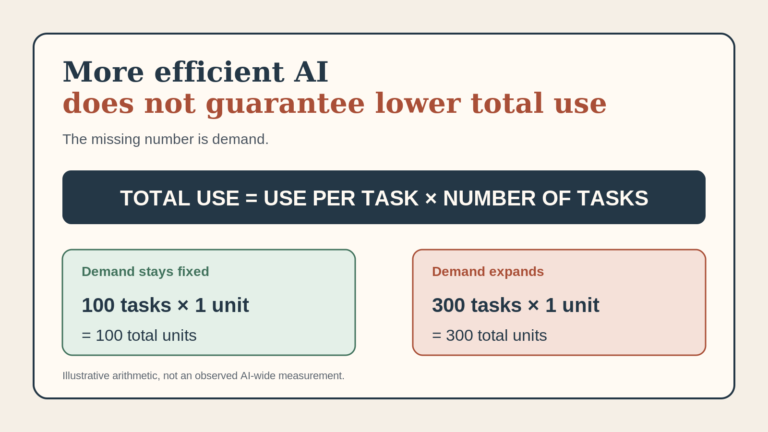
Efficiency can lower the resource used for each unit while higher demand pushes total use up.
Jevons’ Paradox is what happens when an efficiency improvement reduces the resource needed for each unit, but the lower effective cost encourages so much additional use that total resource consumption rises.
That is the strict definition. If extra demand cancels only part of the expected saving, the result is a partial rebound—not the full paradox.
The practical point is simple: a per-unit efficiency number does not tell you what happened to the total.
Where the idea came from
William Stanley Jevons developed the argument in The Coal Question, first published in 1865. In the revised 1866 edition, he argued that more economical use of coal could make coal-powered activity more profitable and increase demand.
Jevons used Scottish pig iron as an example. Coal use per ton fell while iron production expanded sharply, and he argued that aggregate coal consumption increased. Using less coal per unit did not guarantee using less coal overall.
That historical example explains the mechanism. It does not prove that every efficiency improvement produces the same result.
The arithmetic
Suppose 100 tasks each require two units of a resource:
100 tasks × 2 units = 200 total unitsAn improvement cuts resource use per task in half:
100 tasks × 1 unit = 100 total unitsIf demand stays fixed, total use falls from 200 units to 100.
Now suppose the lower cost makes 300 tasks worthwhile:
300 tasks × 1 unit = 300 total unitsEach task is twice as efficient. Total use is still 50 percent higher than the original 200-unit baseline. The increase in activity overwhelmed the saving per task.
Partial rebound is not the full paradox
There are three different outcomes:
- No rebound: Per-unit resource use falls, activity stays about the same, and total use falls as expected.
- Partial rebound: Activity increases and cancels some of the saving, but total use remains below the original baseline.
- Strict Jevons outcome: Activity increases enough that total resource use rises above the baseline.
Calling every increase in use “Jevons’ Paradox” hides the distinction. A serious claim should name the resource, the unit, the starting point, the system boundary, and the period measured.
Why rebound is conditional
Efficiency may lower a price, reduce waiting time, improve availability, or make new uses practical. Existing users can do more. New users can enter. Businesses can expand output.
But demand can also level off. Prices may not fall. Electricity, hardware, regulation, security, human review, or customer demand may limit expansion. An efficiency improvement can reduce total use when activity stays fixed or grows slowly.
The paradox is not an automatic law. It is an outcome to measure.
What this means for AI
“AI became more efficient” is incomplete. Efficient per response? Per image? Per task? Measured in energy, compute, money, time, or emissions?
If resource use per AI output falls and the effective cost falls with it, people may create many more outputs or add uses that were previously too expensive. Total use rises only if activity expands faster than resource use per output falls.
That mechanism is plausible. The available evidence does not establish one economy-wide AI rebound rate.
Alexandra Sasha Luccioni, Emma Strubell, and Kate Crawford argue in their FAccT 2025 paper, also available as an open manuscript, that direct efficiency metrics should be combined with lifecycle and socioeconomic analysis because rebound can undermine assumed environmental reductions. This is an analytical framework, not an economy-wide estimate.
Dongyang Yu and Bingjie Xu report a narrower environmental result in The Jevons Paradox in the AI Era. Among Chinese A-share listed firms from 2010 through 2022, AI adoption was associated with lower carbon-emissions intensity and higher total carbon emissions. The finding is observational, limited to that firm population and period, and does not establish universal causality. The staged evidence review could not independently retrieve the full methods and results, so the claim should remain this narrow.
Shane Greenstein’s short IEEE Micro article applies the Jevons framework directly to AI as an economic question. It is an analytical application, not empirical proof of a general rebound.
Together, these sources justify testing for rebound. They do not justify a universal AI energy-demand forecast.
A practical test
When someone makes an efficiency claim, ask:
- Which resource changed? Energy, compute, money, time, materials, or emissions?
- Efficient per what unit? One response, image, task, transaction, or dollar of output?
- Did the effective cost or usefulness change?
- How much did activity change?
- What happened to total resource use?
- What boundary and period were measured?
- What else changed? Energy sources, quality, regulation, prices, and capacity can alter the result.
If the unit is a work task, a task map can help define what is being counted before you compare totals.
The evidence supports measuring both per-unit efficiency and total use. It does not support assuming that efficiency must increase total consumption—or that it must reduce it.
Bottom line
Jevons’ Paradox is not a claim that efficiency is bad. It is a warning that efficiency per unit and total resource use are different measurements.
Define the resource. Define the unit. Measure demand. Check the total. If total resource use rises above the baseline, the strict paradox occurred. If the saving only shrinks, that is partial rebound.
Source guide
- Jevons, The Coal Question, revised 1866 edition — primary historical argument.
- Luccioni, Strubell, and Crawford, FAccT 2025 — analytical framework for AI rebound and environmental analysis.
- Yu and Xu, Economic Analysis and Policy 90 (2026) — bounded firm-level environmental study.
- Greenstein, IEEE Micro 45(2), 2025 — analytical AI application.
Evidence reviewed through August 5, 2026. Last reviewed August 5, 2026.